
Man with dead weasel accused of Hoquiam assault
HOQUIAM, Wash. (AP) — Police say a man was carrying a dead weasel when he burst into a Hoquiam apartment and assaulted a man.
The victim asked, "Why are you carrying a weasel?" Police said the attacker said, "It's not a weasel, it's a martin," then punched him in the nose and fled.
The attacker was apparently looking for his girlfriend and had gone to her former boyfriend's apartment Monday night where the victim was a guest.
KXRO reports he left carcass behind.
Police later found the suspect arguing with his girlfriend at another location and arrested the 33-year-old Hoquiam man after a fight.
He said he had found the martin dead near Hoquiam, but police don't know why he carried it with him.
A martin is a member of the weasel family.
**Courtesy of the Seattle Post-Intelligencer
I feel this merits a theatrical reenactment.
Showing posts with label Were you aware of it?. Show all posts
Showing posts with label Were you aware of it?. Show all posts
Wednesday, June 1, 2011

Tuesday, March 1, 2011
Were you aware of it? vol. 37: Turkish man crashes own funeral

KONYA – Doğan News Agency (DHA) 'Everyone was shocked when they saw me,' says 72-year-old Durmuş Çıplak (pictured). 'Then I learned they had thought I lost my life in an accident. But I am still alive, thanks be to God.' AA photo
'Everyone was shocked when they saw me,' says 72-year-old Durmuş Çıplak (pictured). 'Then I learned they had thought I lost my life in an accident. But I am still alive, thanks be to God.' AA photo
A man returning from a fishing trip in the Central Anatolian province of Konya was surprised to encounter a group of mourners gathering in front of his house for a funeral – his own.
“Everyone was shocked when they saw me,” 72-year-old Durmuş Çıplak told Doğan news agency, or DHA. “Then I learned they had thought I lost my life in an accident. But I am still alive, thanks be to God.”
It was thought that Durmuş Çıplak had died after a cargo truck hit a septuagenarian riding a bike by the side of the road at 10 a.m. on Monday. The person, who was not carrying any identification, was badly wounded and was rushed to hospital, where he was pronounced dead.
People in the surrounding area told police, who were trying to determine the man’s identity, that the dead bicyclist was Durmuş Çıplak.
Ahmet Çıplak, the man’s son, was then called to the morgue to identify the victim. The son identified the body as his father and began carrying the body home for the funeral ceremony when his neighbor called to say his father had just returned from a fishing trip.
The son then returned the unidentified body to the hospital, just as his father came upon the bereaved mourners gathered in front of his house.
The deceased cyclist was eventually identified as 70-year-old retiree Süleyman Bozer. Durmuş Çıplak attended the funeral.
**Courtesy of Hürriyet Daily News
Thursday, January 20, 2011
Were you aware of it? vol. 36: Mama Pterodactyls
Age old rule of attraction: Male pterodactyls used giant head crests to woo the ladies, rare fossil find reveals
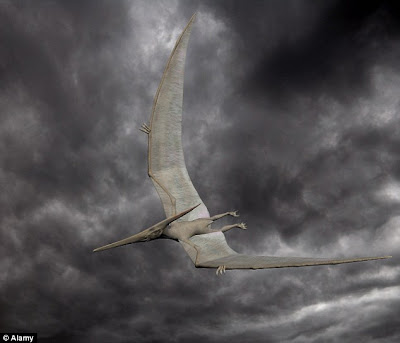
When it comes to trying to impress the opposite sex, men are often unable to resist showing off.
A 160 million-year-old fossil dubbed 'Mrs T' has revealed that dinosaurs were just the same.
Male pterodactyls used their spectacular giant head crests to woo the ladies, scientists believe.
While female reptiles had no decorative markings on their heads, the males sported impressive plumes of feathers, sometimes five times the size of their skull, which they used to show off to prospective mates.
It had previously proved impossible to say whether the remains of the reptiles, which lived alongside dinosaurs between 220 and 65 million years ago, were male or female, and 'sexing' them has foxed experts for more than 100 years.
The evidence comes from Mrs T, the nickname given to a female pterosaur preserved together with the egg she was about to lay.
Pterosaurs - favourites of Hollywood filmmakers - were flying reptiles that lived alongside the dinosaurs, some of which grew as large as light aircraft.
Mrs T was a 160million-year-old Darwinopterus pterosaur whose skeletal remains were uncovered in Liaoning Province, north-east China.
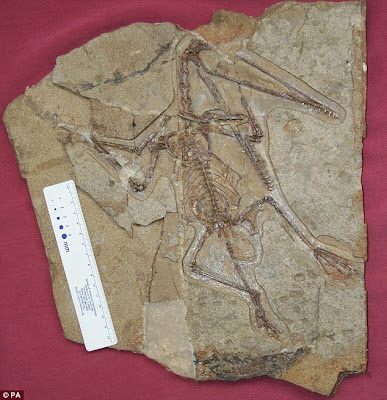
Because she was found with her egg, scientists know that she must have been female.
The pterosaur had relatively large hips to accommodate the passage of eggs, but no head crest.
Other Darwinopterus specimens, now known to be male, have smaller hips and well-developed crests. Scientists believe these were probably used to ward off rivals or attract mates.
Dr David Unwin, from the University of Leicester, whose team describe the find in the journal Science, said: 'Pterosaurs, flying reptiles, also known as pterodactyls, dominated the skies in the Mesozoic Era, the age of dinosaurs, 220 to 65million years ago.
'Many pterosaurs have head crests. In the most spectacular cases these can reach five times the height of the skull.
'Scientists have long suspected that these crests were used for some kind of display or signalling and may have been confined to males, while females were crestless.
'But, in the absence of any direct evidence for gender this idea remained speculative and crested and crestless forms were often separated into completely different species.
'The fossil we have discovered, an individual of Darwinopterus, is preserved together with an egg showing that it must be female. This type of discovery, in which gender can be determined with certainty, is extremely rare in the fossil record, and the first to be reported for pterosaurs.'
Future pterosaur fossil finds in which the skull or hips are preserved can now help scientists to 'sex' the creatures.
Dr Unwin added: 'Gender is one of the most fundamental of biological attributes, but extremely difficult to pinpoint with any certainty in the fossil record.
'Being able to sex pterosaurs is a major step forward. Finally, we have a good explanation for pterosaur head crests, a problem that has puzzled scientists for more than 100 years.
'Now, we can exploit our knowledge of pterosaur gender to research entirely new areas such as population structure and behaviour. We can also play matchmaker for pterosaurs bringing back together long separated males and females in the single species to which they both belong.'
Mrs T is thought to have been laid to rest in the Jurassic mud that preserved her bones by a tragic accident.
She was killed suddenly in a traumatic event that broke her left forearm - perhaps a storm, or one of the volcanic eruptions that were common in northern China at this time.
Unlike those of modern birds, her egg was small with a soft shell.
This was not surprising, since a small, soft egg would require less investment in terms of materials and energy, said Dr Unwin.
Such economy would have offered active pterosaurs an evolutionary advantage and may have been an important factor in the evolution of giant species, like the 32.8ft (10m) wingspan Quetzalcoatlus.
**Courtesy of the Daily Mail.
See also: The original paper published tomorrow in Science.

When it comes to trying to impress the opposite sex, men are often unable to resist showing off.
A 160 million-year-old fossil dubbed 'Mrs T' has revealed that dinosaurs were just the same.
Male pterodactyls used their spectacular giant head crests to woo the ladies, scientists believe.
While female reptiles had no decorative markings on their heads, the males sported impressive plumes of feathers, sometimes five times the size of their skull, which they used to show off to prospective mates.
It had previously proved impossible to say whether the remains of the reptiles, which lived alongside dinosaurs between 220 and 65 million years ago, were male or female, and 'sexing' them has foxed experts for more than 100 years.
The evidence comes from Mrs T, the nickname given to a female pterosaur preserved together with the egg she was about to lay.
Pterosaurs - favourites of Hollywood filmmakers - were flying reptiles that lived alongside the dinosaurs, some of which grew as large as light aircraft.
Mrs T was a 160million-year-old Darwinopterus pterosaur whose skeletal remains were uncovered in Liaoning Province, north-east China.

Because she was found with her egg, scientists know that she must have been female.
The pterosaur had relatively large hips to accommodate the passage of eggs, but no head crest.
Other Darwinopterus specimens, now known to be male, have smaller hips and well-developed crests. Scientists believe these were probably used to ward off rivals or attract mates.
Dr David Unwin, from the University of Leicester, whose team describe the find in the journal Science, said: 'Pterosaurs, flying reptiles, also known as pterodactyls, dominated the skies in the Mesozoic Era, the age of dinosaurs, 220 to 65million years ago.
'Many pterosaurs have head crests. In the most spectacular cases these can reach five times the height of the skull.
'Scientists have long suspected that these crests were used for some kind of display or signalling and may have been confined to males, while females were crestless.
'But, in the absence of any direct evidence for gender this idea remained speculative and crested and crestless forms were often separated into completely different species.
'The fossil we have discovered, an individual of Darwinopterus, is preserved together with an egg showing that it must be female. This type of discovery, in which gender can be determined with certainty, is extremely rare in the fossil record, and the first to be reported for pterosaurs.'
Future pterosaur fossil finds in which the skull or hips are preserved can now help scientists to 'sex' the creatures.
Dr Unwin added: 'Gender is one of the most fundamental of biological attributes, but extremely difficult to pinpoint with any certainty in the fossil record.
'Being able to sex pterosaurs is a major step forward. Finally, we have a good explanation for pterosaur head crests, a problem that has puzzled scientists for more than 100 years.
'Now, we can exploit our knowledge of pterosaur gender to research entirely new areas such as population structure and behaviour. We can also play matchmaker for pterosaurs bringing back together long separated males and females in the single species to which they both belong.'
Mrs T is thought to have been laid to rest in the Jurassic mud that preserved her bones by a tragic accident.
She was killed suddenly in a traumatic event that broke her left forearm - perhaps a storm, or one of the volcanic eruptions that were common in northern China at this time.
Unlike those of modern birds, her egg was small with a soft shell.
This was not surprising, since a small, soft egg would require less investment in terms of materials and energy, said Dr Unwin.
Such economy would have offered active pterosaurs an evolutionary advantage and may have been an important factor in the evolution of giant species, like the 32.8ft (10m) wingspan Quetzalcoatlus.
**Courtesy of the Daily Mail.
See also: The original paper published tomorrow in Science.
Friday, October 1, 2010
Were you aware of it? vol. 35: G is for Goldilocks
 Professor Steven S. Vogt of the Lick Observatory at UC Santa Cruz is apparently 100% sure that life does or will exist on the planet he discovered late last month, affectionately known to the scientific community as Gliese 581 g.
 Gliese 581 g (the planet) lies in the so-called 'habitable zone' of its parent star, the red dwarf Gliese 581, meaning that it's close enough for there to be liquid water -- not boiling, not frozen -- making it just right for life. The planet has a rocky atmosphere and enough gravity to hold onto its atmosphere.
But don't pack your bags yet, as far as science can tell, our little Goldilocks of a planet (or maybe it should be a Mama Bear of a planet??) appears to be tidally locked to its parent star, meaning that the same side of the planet always faces its sun. The border zones where it's eternally sunrise or sunset might be nice, though.
Gliese 581 (the star itself) is located 20 light years from Earth in the constellation Libra.
On All Things Considered.
On Talk of the Nation Science Friday.
Were you aware of it? vol. 34: Explosive Double Feature
"About 75 bystanders, most of them residents who had found the whale to be an object of curiosity before they tired of its smell, were moved back a quarter of a mile away. The sand dunes there were covered with spectators and land-lubber newsmen shortly to become land-blubber newsmen, for the blast blasted blubber beyond all believable bounds."
I admit I derive a childlike glee from the mental image of serious-minded city council men being smacked in the face by fast-moving slabs of rotting whale flesh despite their confidence that 20 cases of dynamite would disintegrate it mid-air. Similarly amusing is the though of filing an insurance claim for a car totaled by the impact of a rotting whale meat-eor.
"Barbara, I've never seen a uh haha a bomb scare quite like this. I mean it's literally a fully clothed bomb expert and a bomb robot with a stuffed animal."
Jezebel puts it best:
Police Save Kids From Stuffed Pony-Terrorist
Wednesday, September 1, 2010
Were you aware of it? vol. 33: The end of history

"It's the World's Strongest, Most Expensive Beer -- Inside a Squirrel"
Our old buddies BrewDog have done it again. Not content with winning back the "strongest beer in the world" title last February with its Sink the Bismarck!, they've now upped their game with a new brew that is 55 percent alcohol by volume and carries a $765 price tag. It's called The End of History.
Oh, and did we mention that the bottles come in stuffed animals-like stuffed animals that were once alive? The 12 bottles have been made featuring seven dead stoats (a kind of weasel), four squirrels and one rabbit. James Watt, one of the two guys behind BrewDog, put it better than we ever could: "The impact of The End of History is a perfect conceptual marriage between taxidermy, art and craft brewing." Just like we've all been waiting for!
For those interested in the actual beer, it's a blond Belgian ale with touches of nettles and juniper berries -- and in order to achieve the brain-blasting alcohol content, it had to be created using extreme freezing techniques.
**courtesy of Asylum
<3 Scots
Sunday, August 1, 2010
Were you aware of it? vol. 32: Sibs
It's still just a factor, obv, but I find the explanation of how birth order affects IQ fascinating. It really is important to expose kids to sophisticated conversation. So true for my family, in any case.
Thursday, July 1, 2010
Were you aware of it? vol. 31: Poisoning pigeons in the park
Tom Lehrer has been all over NPR (what with the release of his new DVD of live footage from a 1967 concert in Oslo), and I've got to say I'm a fan. I've been singing Poisoning Pigeons in the Park and dancing to the Vatican Rag all morning.
Tuesday, June 1, 2010
Were you aware of it? vol. 30: Going back for seconds
In an age where creative marketing is king, even feces can be turned into gold!
 Modern Toilet may well be the most bizarre restaurant ever created.
 Supposedly inspired by manga, they started out selling piles of chocolate ice cream in containers shaped like squat toilets.
By some act of popular revolt beyond my comprehension, this wildly popular business was able to expand and now has multiple locations in Hong Kong, Taiwan and China offering a full range of drinks, hot pots, spaghetti, curry, and gratins -- all served in toilet, bath tub and sink-shaped dinnerware.
Note:
the toilet-shaped soup bowl
the toilet seating
the toilet light fixture
Saturday, May 1, 2010
Thursday, April 1, 2010
Were you aware of it? vol. 28: Raining fish in Australia
 No joke. I am reminded of Kafka on the Shore and Magnolia.
 2 March 2010.
Lajamanu, Australia.
Residents of a small outback Australian town have been left speechless after fish began falling from the sky.
Hundreds of spangled perch bombarded the 650 residents of Lajamanu, shocking local Christine Balmer, who was walking home when the strange 'weather' started.
She said: 'These fish fell in their hundreds and hundreds all over the place. The locals were running around everywhere picking them up.
'The fish were all alive when they hit the ground so they would have been alive when they were up there flying around the sky.
'When I told my family, who live in another part of Australia, about the fish falling from the sky, they thought I'd lost the plot.
'But no, I haven't lost my marbles. All I can say is that I'm thankful that it didn't rain crocodiles!'
Meterologists say the incident was probably caused by a tornado. It is common for tornados to suck up water and fish from rivers and drop them hundreds of miles away.
Mark Kersemakers from the Australian Bureau of Meterology said: 'Once they get up into the weather system, they are pretty much frozen and, after some time, they are released.'
Lajamanu is located half-way between Darwin and Alice Springs, on the edge of the Tanami Desert.
This is not the first time residents of the small town have experienced fish falling out of the sky.
Resident Les Dillon, 48, said: 'In the early 1980s I was at the Alice Springs Tavern Hotel and, when I walked out the door, I saw all these little fish, fallen out of the sky.
'Yes, I had a couple of beers, so none of my friends believed me. I have rung heaps of people to let them know I wasn't drunk back then. It had really happened!'
**Courtesy of the Daily Mail via the Skeptics Guide to the Universe. See the original article for an extra list of crazy things falling from the sky through history.
Plus this from the BBC
Friday, March 5, 2010
Were you aware of it? vol. 27: Alice in Wonderland, take one
Quite a bit more faithful to the original, I must say.
Monday, February 1, 2010
Were you aware of it? vol. 26: Roots, or why we're glad plants stand still

Roots [...] are organs that enable plants to mine the soil for essential nutrients. The intimate contact with the soil mass that roots require for normal function is the reason for plants being sessile during most life stages. Functions such as photosynthesis and nitrogen fixation do not preclude freedom of motion, but the primary acquisition of mineral nutrients from soil does. We and other terrestrial animals have gained our freedom of movement through evolutionary developments that emancipated us from the need to acquire mineral nutrients directly from our environment. This liberation from a sedentary existence in turn led to the evolution of sense organs and coordinated body movements--hence the need for a central nervous system and the evolution of the brain. The triumphs and tragedies of our intellect and our emotions can ultimately be traced to our reliance for mineral nutrients on the fixed, silent plants rooted in the soil.
[...] if intelligent life on solid land is ever discovered elsewhere in the universe, there, as here the world of life will consist of two "kingdoms": plant and animal. Only sessile plants can absorb from a solid substrate the many mineral elements needed for the machinery of life, and only organisms depending on those pants can evolve mobility, sense organs, and the further steps already referred to, culminating in the evolution of sentient beings.
~ Emmanuel Epstein and Arnold J. Bloom, Mineral Nutrition of Plants: Principles and Perspectives, p. 25
Saturday, January 2, 2010
Were you aware of it? vol. 25: What English sounds like to foreigners
According to Adriano Celentano, an Italian singer wrote this song with gibberish to sound like English. If you've ever wondered what other people think Americans sound like, this is it.
There is talk of breaking into the night club scene with some synchronized Prisencolinensinainciusol action. I'm feeling a little jazzercise coming on.
There is talk of breaking into the night club scene with some synchronized Prisencolinensinainciusol action. I'm feeling a little jazzercise coming on.
Tuesday, December 8, 2009
Were you aware of it? vol. 24: How to eat a persimmon

By nature I distrust the Hachiya persimmon (above). Naive to their sinister ways, I once bit into one of their kind when it was far softer than any other fruit I consider palatable, but it was Not Soft Enough! Anyone who has fallen victim to the Hachiya persimmon, who has bitten into them when they retain even the slightest hint of cellular structure knows that the experience is cruel. For the uninitiated, imagine that chalkiness that coats your mouth when you eat a banana that is a little bit too green and then multiply that slight unpleasantness by a million until it is unusual punishment.
I did, however, chance upon a strategy to render even the meanspirited Hachiya harmless. The trick: freeze it. Pop your persimmon in the freezer for 24 hours, then stick it in the refridgerator (or out on the counter if you're going to eat it right away) until it defrosts, and it will be edible mush. Once the stem-let has been removed, this blob can be plopped into oatmeal as a pretty decent sweetener. Or you could whip up some persimmon pudding.
Nevertheless, as someone who prefers to eat most fruits when they have the texture of an apple (peaches and plums notwithstanding), the Hachiya persimmon is not incredibly appealing. I prefer it's friendlier cousin the Fuyu (below). The glorious Fuyu can be eaten raw when it's hard as a rock, just the way I like it. You can toss them in salads or just bite fearlessly into them. Fuyus, in my humble experience, are also not as sickly sweet as Hachiyas, which further raises them in my esteem.
In any case, you have been forewarned. You may now venture forth and enjoy these fruits which may well be at the peak of their season.

Monday, November 16, 2009
Were you aware of it? vol. 23: The Knobcone Pine
Chapter VIII of John Muir's The Mountains of California runs you through the trees that make up the forests of, well, the mountains of California. To my untrained eye, the little black and white line drawings of the various tree genera and species may as well have been identical. Or, rather, all but one, this so-called Knobcone Pine.
John Muir has this to say about them:
Pinus Tuberculata
This curious little pine is found at an elevation of from 1500 to 3000 feet, growing in close, willowy groves. It is exceedingly slender and graceful in habit, although trees that chance to stand alone outside the groves sweep forth long, curved branches, producing a striking contrast to the ordinary grove form. The foliage is of the same peculiar gray-gren color as that of the Nut Pine, and is worn about as loosely, so that the body of the tree is scarcely obscured by it.
At the age of seen or eight years it begins to bear cones, not on branches, but on the main axis, and, as they never fall off, the trunk is soon picturesquely dotted with them. The branches also become fruitful after they attain sufficient size. The average size of the older trees is about thirty or forty feet in height, and twelve to fourteen inches in diameter. The cones are about four inches long, exceedingly hard, and covered with a sort of silicious varnish and gum, rendering them impervious to moisture, evidently with a view to the careful preservation of the seeds. [...]

The Grove Form and the Isolated Form (Pinus Tuberculata)
It is so little known [...] that it can hardly be said to have a common name. Most mountaineers refer to it as 'that queer little pine-tree covered all over with burs.' In my studies of this species I found a very interesting and significant group of facts, whose relations will be seen almost as soon as stated:
1st. All the trees in the groves I examined, however unequal in size, are all of the same age.
2d. Those groves are all planted on dry hillsides covered with chaparral, and therefore are liable to be swept by fire.
3d. There are no seedlings or saplings in or about the living groves, but there is always a fine, hopeful crop springing up on the ground once occupied by any grove that has been destroyed by the burning of the chaparral.
4th. The cones never fall off and never discharge their seeds until the tree or branch to which they belong dies. [...]
Needless to say, I was skeptical. This all sounds a little too fantastical to be true, something of a chimera of the plant kingdom. Except! We were clearing away a giant pile of Black Acacia logs from the base of an old Coast Live Oak, and I found this log about a foot in diameter With Pinecones Stuck Right To It. It was like chancing upon a unicorn horn, I swear to you.
And then! I was wrapping things up at the Botanical Garden the other week, having potted a bunch of vine cuttings, and on my way back to the N Judah, there appears from nowhere an Entire Tree with pine cones growing straight out of the trunk. And not only that, I found another one in one of the vegetable beds at school when we pulled out the sunchokes. I am a believer! However, I have done you the service of not providing any photographic evidence to encourage your skepticism and heighten the drama of your personal discovery. You are welcome.
John Muir has this to say about them:
This curious little pine is found at an elevation of from 1500 to 3000 feet, growing in close, willowy groves. It is exceedingly slender and graceful in habit, although trees that chance to stand alone outside the groves sweep forth long, curved branches, producing a striking contrast to the ordinary grove form. The foliage is of the same peculiar gray-gren color as that of the Nut Pine, and is worn about as loosely, so that the body of the tree is scarcely obscured by it.
At the age of seen or eight years it begins to bear cones, not on branches, but on the main axis, and, as they never fall off, the trunk is soon picturesquely dotted with them. The branches also become fruitful after they attain sufficient size. The average size of the older trees is about thirty or forty feet in height, and twelve to fourteen inches in diameter. The cones are about four inches long, exceedingly hard, and covered with a sort of silicious varnish and gum, rendering them impervious to moisture, evidently with a view to the careful preservation of the seeds. [...]

It is so little known [...] that it can hardly be said to have a common name. Most mountaineers refer to it as 'that queer little pine-tree covered all over with burs.' In my studies of this species I found a very interesting and significant group of facts, whose relations will be seen almost as soon as stated:
1st. All the trees in the groves I examined, however unequal in size, are all of the same age.
2d. Those groves are all planted on dry hillsides covered with chaparral, and therefore are liable to be swept by fire.
3d. There are no seedlings or saplings in or about the living groves, but there is always a fine, hopeful crop springing up on the ground once occupied by any grove that has been destroyed by the burning of the chaparral.
4th. The cones never fall off and never discharge their seeds until the tree or branch to which they belong dies. [...]
Needless to say, I was skeptical. This all sounds a little too fantastical to be true, something of a chimera of the plant kingdom. Except! We were clearing away a giant pile of Black Acacia logs from the base of an old Coast Live Oak, and I found this log about a foot in diameter With Pinecones Stuck Right To It. It was like chancing upon a unicorn horn, I swear to you.
And then! I was wrapping things up at the Botanical Garden the other week, having potted a bunch of vine cuttings, and on my way back to the N Judah, there appears from nowhere an Entire Tree with pine cones growing straight out of the trunk. And not only that, I found another one in one of the vegetable beds at school when we pulled out the sunchokes. I am a believer! However, I have done you the service of not providing any photographic evidence to encourage your skepticism and heighten the drama of your personal discovery. You are welcome.
Sunday, November 1, 2009
Were you aware of it? vol. 22: Back from the dead
As heard on Fresh Air Monday October 12, 2009
DAVE DAVIES, host: Well, Sanjay Gupta, welcome to FRESH AIR. I thought we'd begin with this remarkable story that you tell early in the book of this Norwegian skier who takes a plunge in the mountains and gets trapped in freezing water for something like two hours and manages somehow to recover. How?
Dr. SANJAY GUPTA (Associate Chief of Neurosurgery, Grady Memorial Hospital; Author, "Cheating Death: The Doctors and Medical Miracles that Are Saving Lives Against All Odds"): It is a remarkable story, even for someone like me who's been studying this for a couple of years, who's had the opportunity to travel around the world and talk to the foremost researchers in hypothermia, in extreme survival. This story is sort of the pinnacle of even that. This was a woman who has, I guess, the dubious honor of being the coldest-ever human being who subsequently went on to live. This is a woman who was declared dead in a hospital in Tromso, Norway, and now is a practicing physician at that same hospital.
She was found after she fell into a stream, a sort of frozen stream on a very cold place, and this is Tromso, Norway, which is north of the Arctic Circle in one of the northern-more points of Norway. What we know now is that she struggled for around 30 minutes or so. She was probably getting pockets of air, which is why she could last that long. And then she just stopped, and by the time they got her out of that frozen stream, she was dead. She had no spontaneous respiration. She had no spontaneous heartbeat. She had no blood pressure. Her pupils were dilated, indicating that her brain had become swollen. She was dead, and it was at this point that I think that a critical decision was made. The decision was to go ahead and leave her cold. The idea was that this cold could somehow be protective. It could somehow stimulate an almost hibernation-like reflex in the body. We know that there was no oxygen traveling through the body, but because she was cold, the body wasn't really demanding oxygen, either.
DAVIES: How cold was she? How cold was her body?
Dr. GUPTA: She was 13.7 degrees Celsius, so right around 55 degrees or so. And again, that's the coldest recorded temperature of someone actually surviving, someone surviving.
DAVIES: And how long did they decide to leave her in this hypothermic state?
Dr. GUPTA: Several hours. They did not warm her up at the scene, which is what often happens, even with blankets, and then warm saline and things like that. And they did not warm her up right away when she finally got to the hospital. They waited a few hours and then slowly, very slowly started to re-warm her using these temperature gradients, so just a few degrees at a time.
DAVIES: And what happened?
Dr. GUPTA: What happened is that, you know, they got her in there, and they realized that, you know, she really had no heartbeat. And sometimes you can't tell in the field, you know, it's tough to check a pulse, but now they have - they're doing an echocardiogram, directly looking at her heart, and she really has no heartbeat. So now they're very concerned, and they say we're going to slowly start to re-warm her, and we're also not going to give her any extra IV fluids.
One thing they learned is that when you start to go into this hibernation-like state from cold, from hypothermia, all your blood vessels become very leaky. They just leak fluid. So if you give a lot of fluid, that fluid starts to leak, and if it leaks into the brain or into the lungs, that can cause death.
So they gave no fluids, slowly re-warmed her, and then there was just this great moment where all of the sudden the heart, which was doing nothing - you had true, what's known asystole, that flat line on EKG, and all of a sudden it started to come back. And it was a magical moment as they described it to me when I was visiting them in Tromso, but I think they were still concerned that her brain had gone for too long without oxygen. How could the body tolerate this? But as I said, you know, she slowly recovered. At first, she was paralyzed, almost, in her entire body from lack of oxygen to her brain, but over a period of time, she continued to recover, finished her medical school, which she was a medical student at the time, and is now a doctor in that same hospital.
Monday, October 12, 2009
Were you aware of it? vol. 21: Grocery Store Wars
Yes! Sums it up nicely, in an easily digestible format.
Wednesday, September 9, 2009
Were you aware of it? vol. 20: Good news in Texas
The NYT reported recently on Dan Phillips and his new construction company, Phoenix Commotion, based in Huntsville, TX. With NPR reporting on our continued adventures with the housing crisis, this man is doing some really awesome stuff for his community.
Phoenix Commotion is building low income housing for the Huntsville community by acquiring lots inexpensively and building houses entirely out of salvaged materials. The finished product may not look like the other houses on the block, but they're well designed, totally up to code, and pretty dang good looking.
See for yourself:

Roof made of old shingles.

Osage Orange wood countertop - abundant locally.

Ceiling made of old frame samples.

Cattle bone backed chair.
Phillips insists that future owners help with construction à la Habitat for Humanity, but Phoenix Commotion isn't a nonprofit. Phillips keeps profit margins relatively slim, but he wants to prove that low income housing is viable as a business model. In the process his efforts have helped Huntsville organize channels for the collection and dispersal of salvageable/salvaged building materials.
Even if some of the 15 original owners have been booted out of their homes by the financial crisis (moving the homes into middle class hands), it's a noble effort, and I'm glad to see someone taking on good looking, low income housing.
See the original article.
Phoenix Commotion is building low income housing for the Huntsville community by acquiring lots inexpensively and building houses entirely out of salvaged materials. The finished product may not look like the other houses on the block, but they're well designed, totally up to code, and pretty dang good looking.
See for yourself:


Phillips insists that future owners help with construction à la Habitat for Humanity, but Phoenix Commotion isn't a nonprofit. Phillips keeps profit margins relatively slim, but he wants to prove that low income housing is viable as a business model. In the process his efforts have helped Huntsville organize channels for the collection and dispersal of salvageable/salvaged building materials.
Even if some of the 15 original owners have been booted out of their homes by the financial crisis (moving the homes into middle class hands), it's a noble effort, and I'm glad to see someone taking on good looking, low income housing.
See the original article.
Tuesday, September 1, 2009
Were you aware of it? vol. 19: Sierra Beauty apples
Discovered these at Berkeley Bowl when a man turns to his son and says, "These are the best apples you'll ever have." It's true.

Large, handsome apple with thin green and yellow skin, striped or blushed red. A favorite apple from Boonville, CA. Juicy, very crisp, rich, tart, sprightly flavor. A good seller in farm markets and an excellent keeper.
Generally late blooming. Need full sun, well-drained soil, and moderate fertility. The tree is compact. Unpruned, semi-dwarf trees reach 85% of standard (about 15—25'), but by pruning you can keep your tree to any desired height. Thin fruit to maximize quality and size. Susceptible to codling moth, apple scab, powdery mildew, and gophers. Generally cross-fertile, which means that the variety is not pollinated by itself, but by a different variety of the same fruit. Three or more varieties are best. Harvest 3rd year.
Bloom: Midseason
USDA Zone: 6,7,8,9
Pollination: Self-fertile
Fruit Storage: Excellent
Mature Size: Medium
Ripens: Very Late
Uses: Fresh eating/ dessert, cooking (puree, applesauce, apple butter), baking
Rootstock: Semidwarf
Order an heirloom apple tree.

Large, handsome apple with thin green and yellow skin, striped or blushed red. A favorite apple from Boonville, CA. Juicy, very crisp, rich, tart, sprightly flavor. A good seller in farm markets and an excellent keeper.
Generally late blooming. Need full sun, well-drained soil, and moderate fertility. The tree is compact. Unpruned, semi-dwarf trees reach 85% of standard (about 15—25'), but by pruning you can keep your tree to any desired height. Thin fruit to maximize quality and size. Susceptible to codling moth, apple scab, powdery mildew, and gophers. Generally cross-fertile, which means that the variety is not pollinated by itself, but by a different variety of the same fruit. Three or more varieties are best. Harvest 3rd year.
Bloom: Midseason
USDA Zone: 6,7,8,9
Pollination: Self-fertile
Fruit Storage: Excellent
Mature Size: Medium
Ripens: Very Late
Uses: Fresh eating/ dessert, cooking (puree, applesauce, apple butter), baking
Rootstock: Semidwarf
Order an heirloom apple tree.
Subscribe to:
Posts (Atom)