
Showing posts with label culture. Show all posts
Showing posts with label culture. Show all posts
Saturday, August 28, 2010

Wednesday, August 18, 2010
Oh my god.
Two things:
1. This three year old badass recites poetry better than most adults. Is this what it will take to get into college in the future? Thank god he's not applying to grad school this fall.
2. I really need to read more Billy Collins.
Wednesday, July 14, 2010
Top o' the pops
I am feeling an insatiable appetite for pop culture lately. I am watching Lost. I am following sports. I am even considering listening to Harry Potter as an audiobook. Perhaps most importantly, I think I am going dancing Sunday night.
To warm up, I am watching this. Also because I thought I saw my celebrity crush in it.
To warm up, I am watching this. Also because I thought I saw my celebrity crush in it.
Friday, April 9, 2010
Mesdames et messieurs!
Je vous présente le cirque Calder!
en deux parties...
So amazing and fantastical I sat in the SAM and watched it twice with wonder in my eyes. If I didn't love Alexander Calder before, I would love him now.
People should be doing this now. I want to go see this show.
en deux parties...
So amazing and fantastical I sat in the SAM and watched it twice with wonder in my eyes. If I didn't love Alexander Calder before, I would love him now.
People should be doing this now. I want to go see this show.
Tuesday, January 19, 2010
Adoration, inspiration
I mentioned Alphonse Mucha the other day, and was reminded that the world might be a more beautiful place if more of us were familiar with his art. The man was a god of geometry, botany, dark lines, and voluptuousness, of the magic of nature and how we are part of it.


Thursday, December 17, 2009


Wednesday, December 16, 2009


Tuesday, December 15, 2009


Monday, December 14, 2009
Insects, by Bernard Buffet
I don't think I've ever actually posted anything about one of my favorite artists, M. Bernard Buffet, painter, lithographer, Frenchman.
Here are some of his insects. Beautiful stuff. Butterflies still haven't gotten old. Or maybe it's that he makes them new again.

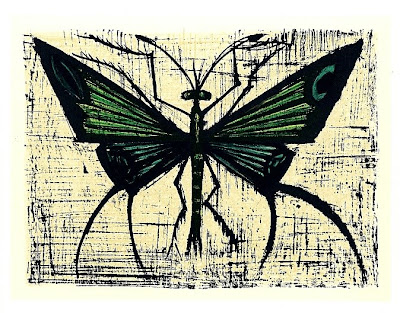


Here are some of his insects. Beautiful stuff. Butterflies still haven't gotten old. Or maybe it's that he makes them new again.


Wednesday, September 9, 2009
Were you aware of it? vol. 20: Good news in Texas
The NYT reported recently on Dan Phillips and his new construction company, Phoenix Commotion, based in Huntsville, TX. With NPR reporting on our continued adventures with the housing crisis, this man is doing some really awesome stuff for his community.
Phoenix Commotion is building low income housing for the Huntsville community by acquiring lots inexpensively and building houses entirely out of salvaged materials. The finished product may not look like the other houses on the block, but they're well designed, totally up to code, and pretty dang good looking.
See for yourself:

Roof made of old shingles.

Osage Orange wood countertop - abundant locally.

Ceiling made of old frame samples.

Cattle bone backed chair.
Phillips insists that future owners help with construction à la Habitat for Humanity, but Phoenix Commotion isn't a nonprofit. Phillips keeps profit margins relatively slim, but he wants to prove that low income housing is viable as a business model. In the process his efforts have helped Huntsville organize channels for the collection and dispersal of salvageable/salvaged building materials.
Even if some of the 15 original owners have been booted out of their homes by the financial crisis (moving the homes into middle class hands), it's a noble effort, and I'm glad to see someone taking on good looking, low income housing.
See the original article.
Phoenix Commotion is building low income housing for the Huntsville community by acquiring lots inexpensively and building houses entirely out of salvaged materials. The finished product may not look like the other houses on the block, but they're well designed, totally up to code, and pretty dang good looking.
See for yourself:


Phillips insists that future owners help with construction à la Habitat for Humanity, but Phoenix Commotion isn't a nonprofit. Phillips keeps profit margins relatively slim, but he wants to prove that low income housing is viable as a business model. In the process his efforts have helped Huntsville organize channels for the collection and dispersal of salvageable/salvaged building materials.
Even if some of the 15 original owners have been booted out of their homes by the financial crisis (moving the homes into middle class hands), it's a noble effort, and I'm glad to see someone taking on good looking, low income housing.
See the original article.
Friday, November 21, 2008
In defense of Norman Rockwell
The people demand reading material, so they shall have the treatise on Norman Rockwell I have been meaning to finish:
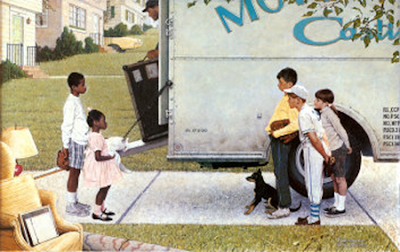
New Kids in the Neighborhood, 1967.
Firstly, I love Norman Rockwell.
When I was a kid, I used to go into Barnes and Noble and attempt to explain to my parents that it was imperative that whatever mammoth-sized tome of Norman Rockwell paintings was laying about absolutely had to come home with me. And they weren't hard to find. I haven't flipped through those books in a while, but I still consider myself a fan. So when it was mentioned to me recently that Norman Rockwell has gotten something of a bad wrap for for painting what is considered trite Americana, my emotions were aroused.
Oh, the injustice of success! To cast aside these aspersions against the innocent, I shall attempt to revisit some of the things that drew me to N. Rock. in the first place and why he continues to kick butt.
Exhibit A. Faces
My ten-year self was v. impressed with the way Norman Rockwell could paint people. I had the darndest time making the people in my youthful drawings look different. It's like - all/most people have two eyes, a nose, a mouth, etc. and in your head, you know what an eye looks like, so you draw two of those, and you know more or less what a mouth looks like so you stick one of those on around where it should be. And no one can draw noses, so you do your best there and then oh look. All these people could be clones.
But Norman Rockwell, artiste extraordinaire, did not have this problem! Ok, so there is a Norman Rockwell face. You can picture it in your head with the expressive hopeful eyes and thin nose and ruddy cheeks, but you can tell the people in his paintings apart - especially in his later paintings. The awe this inspired in my ten year old self has not yet worn off.
For example:
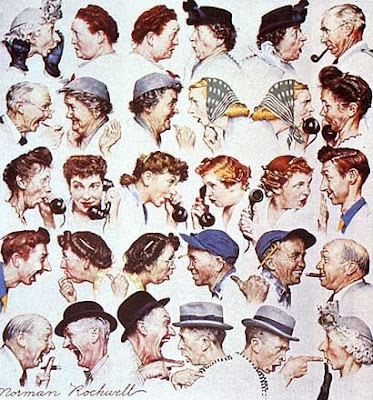
Gossip .
Yes, they are wasp-y, but look how expressive they are too. The man obviously has technical skill.
Exhibit B. Details, details, details
There's never a boring part of a Norman Rockwell painting. Something is always happening in every corner.
Take this, for instance:
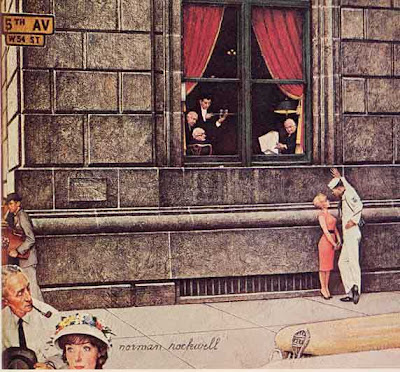
Saturday Evening Post cover illustration, 1960
It's not just about a sailor hitting on a cute blonde. He's got all the old men coming over to the window to watch and the emotional lives of all the people crossing the street. Incidentally, this is one of the few paintings with a little self-portrait of the man himself.
So maybe if he'd zoomed in on the little romantic scene, you'd look at this picture and think, "yeah, yeah sailors hit on anything with legs (or so I've heard)," but now you've got the pedestrians thinking that already for you. And the guys up in the office thinking damn I remember when I could hit on hotties - too bad I'm old now. And one of them has a slingshot?! What's'a matter? Jealous? And just looking at it tells you New York - the little bit of taxi, the throng of pedestrians finally getting to cross the street, and, if you still weren't sure, the street signs.
And all of that is where you get Americana. He makes it not just about the individual, but about our relationships and how we're connected, and I think that connection is why his paintings have that feel-good aspect to them. He painted an America that was about community, rather than just that rugged individualism we go on about.
Exhibit C. The Moment
Henri Cartier-Bresson writes about the decisive moment in photography where you manage to capture in one split second a moment that speaks to an entire story, like that guy about to make a splash of a calm puddle. Painting, though, has the luxury of arranging itself just so to collect just the right images to define a feeling or capture a moment. There's a lot of symbolic painting, obviously, that really goes to town with that - take all of surrealism, for example.
Norman Rockwell, though, has this amazing ability to recognize important moments in people's lives and then translate that into an almost (but not quite) photo-realistic painting that captures all of it and makes it seem familiar.
For example:
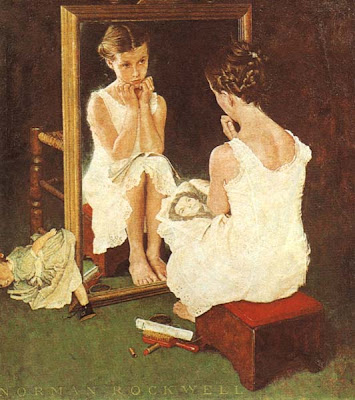
Girl at Mirror, 1954.
Now, some people want to say that Norman Rockwell is cheesy and trite. I take issue with that. These iconic images only seem old hat now because Norman Rockwell got them so right the first time. He got it. And he put it onto canvas. And when those images were plastered the country over on the front of the Saturday Evening Post, he defined America.
I don't want to point any fingers, but, if you need to be reminded, this is more like trite:


Not Norman Rockwell.

Firstly, I love Norman Rockwell.
When I was a kid, I used to go into Barnes and Noble and attempt to explain to my parents that it was imperative that whatever mammoth-sized tome of Norman Rockwell paintings was laying about absolutely had to come home with me. And they weren't hard to find. I haven't flipped through those books in a while, but I still consider myself a fan. So when it was mentioned to me recently that Norman Rockwell has gotten something of a bad wrap for for painting what is considered trite Americana, my emotions were aroused.
Oh, the injustice of success! To cast aside these aspersions against the innocent, I shall attempt to revisit some of the things that drew me to N. Rock. in the first place and why he continues to kick butt.
Exhibit A. Faces
My ten-year self was v. impressed with the way Norman Rockwell could paint people. I had the darndest time making the people in my youthful drawings look different. It's like - all/most people have two eyes, a nose, a mouth, etc. and in your head, you know what an eye looks like, so you draw two of those, and you know more or less what a mouth looks like so you stick one of those on around where it should be. And no one can draw noses, so you do your best there and then oh look. All these people could be clones.
But Norman Rockwell, artiste extraordinaire, did not have this problem! Ok, so there is a Norman Rockwell face. You can picture it in your head with the expressive hopeful eyes and thin nose and ruddy cheeks, but you can tell the people in his paintings apart - especially in his later paintings. The awe this inspired in my ten year old self has not yet worn off.
For example:

Yes, they are wasp-y, but look how expressive they are too. The man obviously has technical skill.
Exhibit B. Details, details, details
There's never a boring part of a Norman Rockwell painting. Something is always happening in every corner.
Take this, for instance:

It's not just about a sailor hitting on a cute blonde. He's got all the old men coming over to the window to watch and the emotional lives of all the people crossing the street. Incidentally, this is one of the few paintings with a little self-portrait of the man himself.
So maybe if he'd zoomed in on the little romantic scene, you'd look at this picture and think, "yeah, yeah sailors hit on anything with legs (or so I've heard)," but now you've got the pedestrians thinking that already for you. And the guys up in the office thinking damn I remember when I could hit on hotties - too bad I'm old now. And one of them has a slingshot?! What's'a matter? Jealous? And just looking at it tells you New York - the little bit of taxi, the throng of pedestrians finally getting to cross the street, and, if you still weren't sure, the street signs.
And all of that is where you get Americana. He makes it not just about the individual, but about our relationships and how we're connected, and I think that connection is why his paintings have that feel-good aspect to them. He painted an America that was about community, rather than just that rugged individualism we go on about.
Exhibit C. The Moment
Henri Cartier-Bresson writes about the decisive moment in photography where you manage to capture in one split second a moment that speaks to an entire story, like that guy about to make a splash of a calm puddle. Painting, though, has the luxury of arranging itself just so to collect just the right images to define a feeling or capture a moment. There's a lot of symbolic painting, obviously, that really goes to town with that - take all of surrealism, for example.

Norman Rockwell, though, has this amazing ability to recognize important moments in people's lives and then translate that into an almost (but not quite) photo-realistic painting that captures all of it and makes it seem familiar.
For example:

Now, some people want to say that Norman Rockwell is cheesy and trite. I take issue with that. These iconic images only seem old hat now because Norman Rockwell got them so right the first time. He got it. And he put it onto canvas. And when those images were plastered the country over on the front of the Saturday Evening Post, he defined America.
I don't want to point any fingers, but, if you need to be reminded, this is more like trite:


Not Norman Rockwell.
Sunday, November 2, 2008
Robert Levon Been of BRMC on what it is about music
I think one of the reasons we still love music but don’t admit to is it’s the last form of magic left on this earth. I mean, in that no one can fully understand or explain why or where it comes from and that’s why it’s kind of a beautiful thing.
**See here.
**See here.
Tuesday, July 22, 2008
Hardly Strictly
Just look:

I haven't even read through the entirety of this list, but I can tell you right now, I know what I'm doing the first weekend of October.
And it's FREE.
Please, if there is a god, don't let Earl Scruggs be the same night as Sigur Rós.

I haven't even read through the entirety of this list, but I can tell you right now, I know what I'm doing the first weekend of October.
And it's FREE.
Please, if there is a god, don't let Earl Scruggs be the same night as Sigur Rós.
Friday, June 27, 2008
Iceland + Björk + Sigur Rós
 Thank you to the Icelandic Tourist Board for always keeping me so well informed:
The good people at National Geographic are webcasting this Saturday's (June 28) concert with Bjork on their website from 3 p.m. to 8 p.m. ET (begins at 8 p.m. BST/London or 7 p.m. GMT/Reykjavik). Fans can see concert only at: worldmusic.nationalgeographic.com
National Geographic Music, will Webcast the open-air Náttúra concert live from Iceland on Saturday, June 28, 2008. Two of the world's most important and visionary musical entities, Björk and Sigur Rós, will headline the free concert.
To be held in a large park near the center of Reykjavik, all of the performances will be during daylight, with Iceland’s capital city and dramatic rolling scenery providing a perfect backdrop to what is expected to be one of the biggest concerts the country has seen. The Náttúra concert looks to raise awareness of the impact of the growing aluminum smelting activity on Iceland’s natural landscape.
“One of National Geographic Music’s main goals is to offer artists and experts who care about global culture and the environment an outlet to create awareness for important issues. Spotlighting these amazing artists performing live in a spectacular backdrop allows our worldwide audience to enjoy great music and become aware of Iceland’s environmental concerns and join the conversation,” said David Beal, president of National Geographic Entertainment.
Takk fyrir (thank you) National Geographic!
Not sure I'll actually be able to see any of it because of band practice all day Saturday, but still!

For all Icelanders' supposed stoicism, they sure know how to rock a concert. I'm so excited to be seeing Sigur Rós at the Greek Theatre this October. I've said it a million times, but seeing them is a religious experience. It's like being lifted out of your body and becoming music itself for two hours.
Also, Noah seems to be down for showing Heima on his projector one of these days. Really, if you haven't seen it, you should.
Tuesday, June 24, 2008
How (not) to write fiction
Normally, I don't like poetry, but I heard this on the radio and thought it was funny.
Tension
outside in the garden,
and suddenly I was in the study
looking up the word oligarchy for the thirty-seventh time.
When suddenly, without warning,
you planted the last petunia in the flat,
and I suddenly closed the dictionary
now that I was reminded of that vile form of governance.
A moment later, we found ourselves
standing suddenly in the kitchen
where you suddenly opened a can of cat food
and I just as suddenly watched you doing that.
I observed a window of leafy activity
and, beyond that, a bird perched on the edge
of the stone birdbath
when suddenly you announced you were leaving
to pick up a few things at the market
and I stunned you by impulsively
pointing out that we were getting low on butter
and another case of wine would not be a bad idea.
Who could tell what the next moment would hold?
Another drip from the faucet?
Another little spasm of the second hand?
Would the painting of a bowl of pears continue
to hang on the wall from that nail?
Would the heavy anthologies remain on their shelves?
Would the stove hold its position?
Suddenly, it was anyone’s guess.
The sun rose ever higher.
The state capitals remained motionless on the wall map
when suddenly I found myself lying on a couch
where I closed my eyes and without any warning
began to picture the Andes, of all places,
and a path that led over the mountain to another country
with strange customs and eye-catching hats
suddenly fringed with little colorful, dangling balls.
--Billy Collins
**Courtesy of the Paris Review
I wonder if longer form fiction really is too heavy handed to pull something like this off. Or maybe it's just that poetry can get away with cheap jokes? Still, I like what he's doing here. The same way I like it when you can bend the rules to your advantage. When it's so easy to fail at that and sound trite. It reminds me of how I love language and makes me want to play with it, but I don't think you have to stick to poetry for that.
In any case, he seems like a decent guy, this Billy Collins. So maybe poets aren't all bad.
Tension
“Never use the word suddenly just toSuddenly, you were planting some yellow petunias
create tension.”
—Writing Fiction
outside in the garden,
and suddenly I was in the study
looking up the word oligarchy for the thirty-seventh time.
When suddenly, without warning,
you planted the last petunia in the flat,
and I suddenly closed the dictionary
now that I was reminded of that vile form of governance.
A moment later, we found ourselves
standing suddenly in the kitchen
where you suddenly opened a can of cat food
and I just as suddenly watched you doing that.
I observed a window of leafy activity
and, beyond that, a bird perched on the edge
of the stone birdbath
when suddenly you announced you were leaving
to pick up a few things at the market
and I stunned you by impulsively
pointing out that we were getting low on butter
and another case of wine would not be a bad idea.
Who could tell what the next moment would hold?
Another drip from the faucet?
Another little spasm of the second hand?
Would the painting of a bowl of pears continue
to hang on the wall from that nail?
Would the heavy anthologies remain on their shelves?
Would the stove hold its position?
Suddenly, it was anyone’s guess.
The sun rose ever higher.
The state capitals remained motionless on the wall map
when suddenly I found myself lying on a couch
where I closed my eyes and without any warning
began to picture the Andes, of all places,
and a path that led over the mountain to another country
with strange customs and eye-catching hats
suddenly fringed with little colorful, dangling balls.
--Billy Collins
**Courtesy of the Paris Review
I wonder if longer form fiction really is too heavy handed to pull something like this off. Or maybe it's just that poetry can get away with cheap jokes? Still, I like what he's doing here. The same way I like it when you can bend the rules to your advantage. When it's so easy to fail at that and sound trite. It reminds me of how I love language and makes me want to play with it, but I don't think you have to stick to poetry for that.
In any case, he seems like a decent guy, this Billy Collins. So maybe poets aren't all bad.
Saturday, February 16, 2008
The kind of picture that reminds me of that Rodin in the LACMA sculpture garden

** borrowed from the Brooklyn Vegan, who I presume borrowed it from Thomas Bartlett?
The question still remains, though, whether that gripping sense of capturing a single moment really translates as well in photography. I think that sense is dulled on us. When you see an enormous bronze monolith captured in a moment in space, it seems more real, and I'm jealous of sculpture for that even though Henri Cartier-Bresson might argue that the definitive moment is photography.
In any case, I really like this image. I like the movement and the use of focus. And, of course, the way black and white lets you see form without being distracted by color. I like an image that lets you complete a motion in your mind, that lets you put on (or take off?) his jacket, follow him onstage and absorb the lights as the music starts. In a word, engaging. I like an image that is engaging.
Subscribe to:
Posts (Atom)